Showing posts with label Books. Show all posts

Friday, 24 November 2017

For Good: The Church and the Future of Welfare by Samuel Wells et al Reviewed

There are various stories around the decline in the significance of the Church in the UK. Some start in the mid to late 1800’s, others focus on the first world war, some look at the changes in British society in the late ‘60’s whilst more argue it is to do with the introduction of the welfare state in the mid 1940’s. In truth it’s probably most appropriate to draw a timeline which marks all of these as significant stages in a process, which have differing significance to different denominations and churches. For Good: The Church and the Future of Welfare by Samuel Wells with Russell Rook and David Barclay lay out an argument which focuses on the argument that the introduction of the Welfare State was the key point of significance. Hence this book engages with a re-evaluation of how the Church can engage with the review of welfare occurring 75 years after the Beveridge Report.

The significance of the date they choose to effectively link secularisation to matters, because it underlines a narrative which can be used to argue that the state has come in and replaced some of the functions of the church in providing care, education of the young and support those in distress. To argue that these were the “right functions” for a church in a society one has to buy into the argument, to some extent at least, that Christianity should have a privileged position in society where it is the recognised provider of essential services. Therein lies my problem with what is excellent a really good book which has some excellent arguments which I will go on to talk about.

There is a catch 22 situation which was excellently illustrated by Steve Chalke, of the Oasis Foundation, at the launch event for this book, which took place at Lamberth Palace. At the conference Chalke, one of the speakers, spoke about the need for infrastructure and governance to be in place for effective engagement at a national level in the provision of goods and services. He identified why, certainly regarding infrastructure, the Church of England was able to do this in ways others aren’t because they are a state church with a parish system. Yet, he was the only speaker that day to talk of spirituality rather than the Church/ Christianity or occasionally faith. The Oasis hub project in Birmingham which is one of the case studies in the book is also the only one which stems from the values we associate with spirituality and Christianity rather than from a congregation looking at how they can help the community, and seeks to work in a truly collaborative way where people are done “with” rather than “to”. Whilst the others reflect these values this hub has this as it's primary purpose rather than an additional one, which a congregation has. His organisation is also the only one to have actively, and I use this word advisedly, seek to oppose institutional homophobia and trans-phobia rather than seeking to protect privilege by continuing to give people the right to discriminate. (see their about section on their website).

I underline these points at the start of my review because they are important in understanding the unease as well as feelings of joy and hope this book unleashed in me as I read it.

The book is essentially as is recognised a report, and as such is too short to be truly nuanced. At 90 pages it can only ever be an overview. Hence, I think having a set of underlying assumptions which are not properly argued.

However, as I said it is a valuable text which provides much hope and gives a useful tool for thinking through social engagement in the contemporary society.

The biggest contribution I think this book makes is seeking to move from a deficit approach (which is what Beveridge took) to an asset based approach. Where as Beveridge said there were five great giants to be slayed (and if you’re not familiar I would point you to You Tube and a rather useful revision guide from History Helper) Wells et al argue there are five great goods society should be aspiring to: relationship, creativity, partnership, compassion and joy.

We have to be careful when talking about these things because focusing on the assets can detract from identifying the reasons these are lacking in our society and dealing with the root causes. This is avoided by the approach of dealing with some of the root causes by focusing on the assets as active verbs rather than simply ends to be achieved. It is an approach which can be seen in the case studies given.

Another strength of the book is it’s recognition of the need for flexibility and fluidity in approaches of social action looking across the spectrum from contradiction to co-operation. This is talked about in a real way which recognises what might start as a protest can end up in active collaboration with those who were at some point in the process “the opposition”.
There are also practical warnings in the book regarding making sure a project is fit for purpose and time sensitive.

So would I recommend it, yes but with the caveats referred to earlier. I’d also recommend some useful supplementary reading to go alongside it though, in order to develop it into the most useful text it might be.

The first text is Sherry Turkle’s Reclaiming Conversation: The Power of Talk in a Digital Age. My reason for suggesting this as accompanying reading is that it looks at the way modern developments in technology are acting as barriers to the assets being discussed and diminishing these assets in our modern society. It is not a Luddite text, but rather it articulately discusses how our technology is a tool which we need to use well. Churches and Christians need to be as aware of their use of technology as other sectors.

The second text which I would suggest the reader engage with is Michael Volland’s The Minister as Entrepreneur: Leading and Growing the Church in an Age of Rapid Change. This book both provides a theological exploration of the approaches being advocated in the Wells text as well as some practical pointers on how to go about this. It also deals with some of the criticisms that might internally be leveled against congregations and ministers taking the type of approach advocated in the book.

A third text, for those wanting to see some different case studies and to examine how spirituality and supporting social action can come together would be The Pioneer Gift: Explorations in Mission edited by Jonny Baker and Cathy Ross. (Which I have also reviewed in the past on this blog)

My final piece of accompanying reading would be Prophetic Dialogue: Reflections on Christian Mission Today by Stephen Bevans and Roger P. Schroeder. This enables one to reflect on how context matters and how to shape this type of work as Christian but in a society which is more pluralistic than the Wells text might acknowledge. 

Friday, 18 August 2017

The Trans Partner Handbook Reviewed by Jo Green Reviewed

The Trans Partner Handbook: A Guide for When Your Partner Transitions by Jo Green is a new guide that’s come out to help support the partners of trans* people, particularly those who are going through transition. It contains good advice from the author and stories and experiences of other partners too. The author herself is the partner of a trans woman and runs one of the main online support groups for partners of trans* people.

I have to say I am one of those who has shared their experiences and so this is not an impartial review. I was privileged to be able to share my experiences in the hope it will help others.

One of the things I like about this book is that it has the right balance of information and stories. The information is comprehensive and very useful. It also shows everybody’s journeys are different but there are some feelings many have in common. It also has a good mix of straight and LGB partners, as well as partners of trans male and trans female people.

With regard to what the book it is split into two halves: The Partner Experience and Transition. The first section includes issues as diverse as Finding Out Your Partner is Trans, Coming Out, Sexuality, A Partner’s Gender Identity, Sex, Mental Health, Counselling and Therapy, Loss and Grieving and Children, Fertility and Adoption. The second half looks at Social Transition, Medical Transitioning and Legal Transition. The resources section is one of the most comprehensive I have come across. Also it is easily readable and does not come across as a text book.

The book is one I would highly recommend to partners but also those who want to understand more about how to support the partners of trans people and what they are going through.

It is a secular book and those readers of this blog who come from a faith perspective need to take that into account at points when opinions are given which may not fit in with their view of life (particularly near the beginning when the author address those readers who may be involved in polyamorous relationships for example). As I say though a really important book which I would highly recommend.


Wednesday, 16 August 2017

Unpopular Culture by Guvna B Reviewed

So I didn’t initially intend to buy Unpopular Culture by Guvina B, which apparently came out in June. However, I did buy it when I found out that he featured heavily in the current issue of the Premier Christianity magazine and that the whole book was only 99p more than the magazine in our local book store, (which had a promotional discount on it). I figured I may as well read the whole book rather than the magazine. What follows is my review.

For the uneducated Guvna B is a MOBO winning British rapper. I could get into the categorisations here but as he says in the book he’s not a big fan of labels and to be honest I’m old and remember when it was as simple as “rap” “hip hop” and “electro”. There’s been times in  his career has been harmed by being pigeon holed as a Christian or gospel artist.

Whilst this book follows a certain evangelical path it is not your usual “trot it out and get them in” paperback. Whilst it’s clear that he has and does perform at big evangelical events it’s equally the case that he points to faith being a journey rather than being “an event”. This is refreshing and reflects the overall honesty which comes through the book.

Early on he briefly talks of his own experience of growing up on a council estate in an area which underwent gentrification as a result of the Olympics. Within this he talks of aspiration and makes clear that those who live in social housing do have aspiration but it tends to be more material and short term than the aspiration with delayed gratification.

I found the material about educational achievement interesting and frustrating. He went on a path of progression which involved doing not so well in his GCSE’s. really not good in his AS Levels but then turning it round to get to university. This path is not unusual but it is increasingly being cut off to people. A Level departments no longer exist in a lot of colleges and the modular system has been abandoned. Whilst he is not overly positive about his university experience it is clear it is “the way out” for many of those young people in social housing (and elsewhere) who do have that long term aspiration.

Now, when it comes to the aspiration “cycle” he makes clear that we need to encourage people to be themselves and own the gifts God has given them. The school, job, relationship, mortgage, family repeat cycle is one which can have negative aspects to it if that is the only goal somebody has.

So you can see a lot of wisdom in this book. It also contains a more positive take on social justice than some books of this type can. As well as talking about supporting a child through the Compassion sponsorship scheme he talks about really engaging in issues. As somebody who says they were desensitized to a lot of things for a long time he says if you start looking at the news and thinking about how you would react if you were seeing your own family it makes a difference. He also mentions, explicitly at various points, the topic of police brutality including the case of Eric Garner.

So do I recommend this book or is it just for young people? Well, I found it useful and at times challenging. Yes, I could get through most of it in the time it took me to drink a large glass of white, but so what. This young man has some important things to say and they appear to being said with integrity. His basic bible teaching isn't bad either.

He does mention the difference of writing for a Chrisitan and secular audience and I have to say I’d love to have read what he’d written if it was for a secular rather than a Christian publisher and with a secular audience in mind to sell to. Still he has a living to make and so do his publishers and so this is the book we get and I have to say it isn’t a bad read all things considered.


Saturday, 12 August 2017

Doorways to the Sacred by Phil Potter & Ian Mosby (eds) Reviewed

Doorways to the Sacred: Developing Sacramentality in Fresh Expressions of Church edited by Phil Potter and Ian Mobsby is the latest book in the Ancient Faith, Future Mission series. As with other books in this series it is predominantly Anglican in it’s outlook, whilst trying to be an ecumenical book and is made up from contributors based in the UK and USA. These include people like Graham Cray, Lucy Moore, Sue Wallace and John and Olive Drane who many will be familiar with.

The book looks at various sacraments: baptism, confirmation, the Eucharist, healing and confession raising questions relevant to their use in missional communities. The book appears, to the outside reader, to have two aims. Firstly, to argue the importance of the sacraments and look at how they might appear in missional communities and Fresh Expressions. Secondly, this book appears to be seeking to give a reasoned argument as to why some of the “laws” or “rules” around the sacraments that the church has need to be re-examined to give more room for them to be contextually appropriate. The book shows how the rules around who should and shouldn’t be taking communion, for example, are already being broken with regard to everybody – baptised or not – being able to come to the table in many situations and words being used which are more contextually appropriate than some of the official liturgies. In her chapter on communion and Messy Church Lucy Moore talks of now being at a point of entering negotiation with the Liturgical Commission.

The book is also interesting for those of us who have been following the literature for many years by showing where some of the people and missional communities themselves have moved onto as time has progressed. It outlines how some have taken the journey from “post-evangelical” to Anglican vocation on to parish priest seeking to use what they have learnt in their missional communities in deprived parishes. Ian Mobsby is interesting in that he has moved on from Moot and in his current appointment is becoming a mixed economy parish containing both “traditional” community and “fresh expression”. Similarly in the USA Karen Ward has moved from a “hipster, arty community” in Seattle to seeking to develop a new community in a poor parish in Oregon. It has Reagan Humber, who is one of the priests at the House of Saints and Sinners in Colorado talking about their recent move of building as well as about the open policy they have, which readers of Nadia Boltz-Weber’s books will be familiar with.

Cray starts by talking about how sacraments are useful in our contemporary world but they have to be something which take us beyond our current yearning for individual experience. This is something which is echoed by other authors, but as John Drane points out it can be that individual experience within a corporate ritual which enables somebody to have a moment with God where they become oblivious of everything and everybody else. Sue Wallace uses the example of the Eucharist being the Tardis which enables us to go back to the foot of the cross – which I think is a good example for showing how sacraments can and should be both communal and individual experiences both at the same time.

With regard to who should take the sacraments and whether they should be truly open to all this is explored in the book. As one might expect the overwhelming response is they should be. However, there are some useful points made about why boundaries or careful handling may be needed. Ian Mosby talks of the value of confirmation as a sacrament but how we need to ensure that it is done of a young person’s own free will and certainly not just to help said young person get into the religious school of their choice. As somebody who made my own daughter argue her case for “adult baptism” before I would give permission – wanting to ensure that it was done from a point of belief not “fitting in” I echo what he is saying. 

Jonathon Clark has an interesting chapter where he looks at how baptism can be open but it needs to be seen as a commitment to a community rather than an individualistic act.
The book is split into five main sections: Sacraments in Context and Culture, Sacraments in Formation and Worship, Sacraments in Initiation, Sacraments in Eucharist and Holy Communion and Sacraments of Healing, Confession and Reconciliation. However, as one might expect with this type of book Eucharist and Holy Communion does tend to dominate.
The most interesting section of the book for me was the final one on healing, confession and reconciliation. With my low church background I had never thought of confession as a sacrament. Yet, it is an important one as Bryony Davis who mixes prison chaplaincy with leadership of a missional community in Surrey (not linked to the prison context) explains within her chapter.

I think that this section is important because whilst other chapters allude to working with survivors this section directly relates to it, (amongst other groups). There is a huge work to be undertaken with regard to this area and it is something that I believe churches are only just beginning to get their heads around. Missional communities by their nature of working “on the margins” to some extent are useful sources of wisdom on this work. Yet, as Julie Leger Dunstan makes clear there is a difference between what is occurring in these contexts and counselling. She highlights the place of spiritual directors in being able to hear confession, but not being counsellors (as they are very clear they are not there to be).

The one real nod to UK ecumenicalism, apart from some of the comments in Lucy Moore’s chapter comes in a moving chapter from Simon Sutcliffe who talks of reconciliation rather than confession. He argues that this sacrament is deep in Methodist DNA if one looks back at the class meeting structure, yet he says as Methodists we only tend to concentrate on communion and baptism as the sacraments.

So is this book worth a read? I would say yes if you want to think through what sacraments are in a way which is non-threatening. I say this as somebody who values ritual but finds the rules of the church with regard to who can and can’t do things related to sacramentality and how they have to be done “properly” difficult to get my head around. This book speaks into my experience and the times I have found the eucharist most special being ok. These experiences came in festival fields where nobody knew who was what and my CP blessing / wedding when we had an open communion table in Bletchley Park. Excluded from the church building in that situation due to what our birth certificates said about gender we were able to have a table in space where all were truly welcome in what was effectively a pop up church where the ball room became church for that hour.


If you are somebody who is hung up on “proper polity” you might find this a difficult read, but that’s good too because we need to find ways forward. We need to find ways where the traditional is fully respected but also all are open to receive the invitation to wholeness God which the sacraments offer.

Saturday, 5 November 2016

Bringing in the Sheaves by Rev Richard Coles - Reviewed


It took me a couple of chapters to work out that Richard Coles was going through the year in his book Bringing in the Sheaves: What and Chaff from My Years as a Priest. To be honest I have to admit part of the reason it took the first three chapters was he starts with Petertide rather than advent or January. As with a lot of things in this book there is reason for this and explanation given. The structure of the book is this version of the liturgical year – with hatching, matching and dispatching, thrown in there too.
It also took me a few chapters to get a hang of what type of book this was. The style of writing is quite different to his first volume of his autobiography Fathomless Riches or How I Went from Pop to Pulpit (which I reviewed here). Where as that is based around anecdote and self-reflection with a bit of education mixed in this is a much more focused book. It has the clear purpose of raising religious literacy amongst its readers whilst giving the stories and titbits of gossip which keep it interesting for those whose tastes might generally be a bit more low brow.

Besides an unpacking of the meaning of different parts of the church year and the anecdotes there is also a rich seam of history running through this book. Coles looks at the lives of a range of saints too and demonstrates his pure passion for as well as in-depth knowledge for church history.

Having read the first books reflections on his time at Mirfield I was surprised that it got mentioned so often in this volume, as somewhere he had chosen to revisit.

He is still the wonderful camp guy making the point that he is determined to be open about his sexuality, yet he is also the happily “married” (legally civil partnered) guy who shares his life with the man he loves and their dogs.

The broadcasting career is in there but more interesting are his anecdotes relating to “ordinary” folk he comes across in the course of his ministry which has been to the very rich, the very poor and the standardly middle class.

So is it worth the read? Definitely but be prepared that this is much more Guardian Review than the Saturday Guardian Guide in style.

It is touching in places, particularly when he talks of his dad’s Parkinson’s, hilarious in others and overall enlightening. You learn lots without feeling that you are being hit over the head with it.

The overall feeling of this book is it is the one which Coles wanted to write. The one which enables him to write a theology book for the masses. Thus the biggest feeling I came away with was this guy has integrity. He’s not playing games, he’s writing the book he wants to. He is not worried it’s probably too faith based for some people outside the church and too honest for some in it. That’s what makes it so good, in my opinion – it’s an honest book written by a clever bloke who got famous through low culture but really has a heart for high culture.


Tuesday, 17 May 2016

This is my body - C. Beardsley & M. O'Brien Ed's Reviewed


This is my body: Hearing the theology of transgender Christians edited by Christina Beardsley and Michelle O’Brien is a collection of contributions by people connected with the Christian trans group Sibyls.
 

The introduction to the book acknowledges the lack of voices from trans men and younger people. I think the lack of a voice from cis partners of trans people is also a loss in a book like this which is not exclusively trans, containing the voices of allies as well. It is not that young and f to m Christians don’t exist, rather I think they are more likely to access different networks (often for LGBTQ+ Christians now LGB Christian groups are becoming more welcoming to T members). Something touched upon in relation to secular f to m groups by the editors as they seek to give an explanation.

The book is a hybrid of academic articles and personal stories. This works to some extent, as does the decision to include all contributions to the stories, however brief. However, I do think that the disjuncture between academic or pseudo-academic articles and many of the stories is such that a book and a pamphlet would have been more helpful. Additionally a couple of the contributions are so brief one does wonder if it would have been more helpful not to include them if something more could not have been coaxed out of the writers.

The first main chapter by the editors talking about The Sybils Gender, Sexuality and Spirituality workshop was particularly strong. Within it there was interesting use of labelling theory and it’s bringing into focus of intersectionality. We all have a sexuality of some kind (even if that is not binary or is a sexual orientation linked to a lack of attraction) and a gender (again even if that is non-binary). This workshop seeks to look at how these factors intersect and how they further relate to our spirituality. The way people have responded to this workshop was also interesting to read.

The next chapter; Acting like a man-playing the woman: gender in performance which is solely authored by Beardsley uses historical analysis of theatre and performance in order to rebuff some of the assertions made by Oliver O’Donovan (a theologian whose work has put forward a range of unhelpful and incorrect notions regarding gender). This was one of the parts of the book which appealed to the social historian within me.

Jasmine Wooley put together a chapter on the social construct of gender which was useful in the way it explained the way that people’s understanding of being trans is often linked to their role as social actors. This is not to suggest that being trans is a choice, rather it highlights as the symbolic interactionists do the way in which we “perform” in relation to the “other” and form our identities around what is expected of us and the fears of what will happen if we deviate from that. Whilst the discussion around legislation was helpful and positive I was disappointed that the discussion of the Marriage (Same Sex Couples) Act (2013) did not acknowledge the negative aspect of that legislation for trans people and their partners who are within a civil partnership. There was a really interesting short section towards the end of this chapter on the challenges presented by the medical model, I was disappointed this had not been slightly longer. However, the chapter covered a lot of ground.

Michelle O’Brien’s chapter on Intersex was particularly interesting and moving. It wove together personal testimony with research. This was the chapter I learnt most from.

This first part of the book for me was the strongest. The chapters became more academic as they moved onto the Theology and Trans chapters. Mercia McMahon sought to reflect on the way in which queer and feminist theologies can help in developing a trans theology. In doing this she also sought to think about how the untimely death of Althaus-Reed, a former professor of divinity in Edinburgh, put back the development of a trans theology. Whilst this chapter did do some useful thinking I think there was an issue in not bringing into play other liberation theologies such as womanism.

Beardsley put together a second solely authored chapter which engaged with the Church of England document “Some Issues in Human Sexuality”. It was a useful update of an earlier article and was interesting in that it gave some of the background to where the current discussions are coming from. This was followed by a chapter looking at a group discussion on the issues within the paper on Issues in Human Sexuality. It ended with some useful recommendations for churches.

Section Three was Scientific and Other Perspectives. This part of the book was the one which I found most difficult to engage with, particularly as a non-scientist. The first chapter by Terry Reed of GIRES was interesting and I was able to follow it. It dealt particularly well with non-binary identity.

Then came Chris Dowd’s chapter Five things cis folk don’t know about Trans folk because it isn’t on trashy TV – my right of reply. Chris is a  URC minister  and ally who came from a MCC background. This paper was based upon his PhD paper. Now, I have to admit a lot of my reaction to this chapter came from the persistent use of the word “folk” which annoys me. To me “folk” is a type of music and the only time I hear it used in relation to people is by Christians. Aside from that it is not a bad chapter which highlights the misconceptions many people have about trans people.

Susan Gilchrist’s paper sought to mix history, science and theology in what was essentially a psychology paper. As a non-scientist I found it overly academic and the least helpful chapter within the first part of this book.

The second part of the book, as I say contained personal stories. The historical ones of these were enjoyable and informative. It was interesting reading these to reflect upon how they were from a particular generation and I did wonder how they would contrast with younger people’s stories had they been in there.

Cross dressing was discussed and I think the most interesting and useful was a self-interview with Elaine Sommers.

The saddest chapter came from well-known trans activist Helen Belcher whose story told of her move to atheism, in part as a result of the awful treatment she had received from the church.

These stories were the most important part of the book to me in many ways because they highlighted what bad practice in the church can look like, as well as what better practice is like. The stories of partners were also touched upon, although as I say I think it would be useful for them to have been told by the partners themselves.

With regard to the contribution by allies I found them interesting and at points offensive. How, even in inverted commas the T word got into the book I have no idea. It would be like writing a piece about ethnicity and using the N word to talk about when you first met a black person.

So would I recommend the book? Yes, if you want to understand more about the experience about older trans people or if you want to explore some of the historical or theological issues involved. If you want a quicker and easier read that just tells you about somebody’s experience of being trans and Christian I would recommend Rachel Mann’s Dazzling Darkness.

Saturday, 2 January 2016

Chasing Francis by Ian Morgan Cron Reviewed and a Journey Begun


Chasing Francis: A Pilgrims Tale by Ian Morgan Cron is an interesting book which is put forward as a novel, but has a study guide at the back (which is significantly different to thoughts for a book group). The reviewer will reach different conclusions depending on how they view this book. If you see it primarily as a novel you will think it is mediocre and not detailed enough to be a decent novel. However, if you regard it as a Christian teaching book it scores extremely highly.

It focuses around an evangelical pastor who experiences a crisis of faith and ends up in Italy learning about St. Francis of Assisi and exploring how his teaching may be lived out today.

I personally found it an interesting and challenging book. It was interesting in how it put forward some ideas regarding what faith in a late/ post-modern world might look like and because of how it used narrative to explore these ideas. It was challenging because however comfortable one might be with the theological ideas underpinning what was being said it was clear that few of us, apart from a few exceptional individuals, are living this stuff out.

I was challenged about how out of line my life is with the faith I profess as a result of reading this book and I am sure that is where the study guide comes in useful. There is also a useful bibliography at the end of the book making clear that any pretence this is a novel in the normal sense should be abandoned.

Am I glad I have read it and would I recommend it? Yes, certainly especially to those who are weary with faith or wondering what on earth God is calling them into as Christians in 2016. I’d also recommend it to those who might want to be exploring Christian spirituality who have a cynicism about the church. It shows that there is another way possible and in small pockets people are seeking that vision and living it out.
I intend to go through the study material and will share my thoughts on that on here in due course. What I am interested in thinking about though is if anybody else would be interested in reading the book and joining in a discussion on it with me? I'll leave that question hanging a few days and if anybody is up for it can you let me know what date you think you'd be able to read the book by so we can set a date for the first study section discussion.

Tuesday, 22 December 2015

Pioneer Spirituality edited by Jonny Baker and Cathy Ross reviewed


Put this up on my review blog earlier. Realised that it may be interesting to readers of this blog too. Pioneering Spirituality: Resources for reflection and practice edited by Cathy Ross and Jonny Baker, published by Canterbury Press, is the latest work from the CMS stable.

Whilst distinctly different from its predecessor , which I reviewed last year -The Pioneer Gift ,it still has the familiar format of having a range of chapters from practitioners in a range of contexts. The work that Baker and Ross do involves seeking to facilitate the hearing of voices which might not otherwise be heard. This has primarily involved seeking to ensure that it is those who would describe themselves as pioneers whose stories and theological reflections are heard.

The scope of contributors to this book seems wider than in previous texts of this kind. It seems that going beyond the traditionally recognised type of fresh expressions and pioneering projects they are engaging more widely with different types of pioneering. This includes hearing the voices of Harvey Kwiyani who is one of a group of Malawian pastors living and working in Nottingham and Berdine Van Den Toren-Lekkerkerker and Benno Van Den Toren who are originally from the Netherlands but have worked in various parts of the world. The former discusses African Spirituality in Western Contexts and the latter From Missionary Incarnate to Incarnational Guest: A Critical Reflection on Incarnation as a Model for Missionary Presence. There is also a chapter by anti-FGM activist Ann-Marie Wilson, who started 28 Too Many, on An Active Spirituality for Mission.

That said there are the familiar type of Pioneers in here too such as Gavin Mart of Engedi Arts who is a Methodist Venture FX Pioneer. Whilst Ross and Baker are careful not to speak with the voices of academics, rather presenting their introductory chapter in a more conversational form the academic voice is here too. Not only via Ross (and to a lesser extent Baker) but also through Stephen Bevans of Catholic Theological Union in Chicago. Bevans chapter Dancing with the Missionary God: Towards a Mission Spirituality seeks to identify six constant features of spirituality which provide a template for those engaged in pioneer mission.

The Bevans chapter is one which seeks to invite the practitioner to reflect on their own spirituality and seek to identify what both unpins it but also what sustains it. This concept of ensuring the pioneers own spirituality is sustained and the sharing of ideas and practices to help with this is the focus of the first part of the book. The most powerful chapters on this topic I believe are Kate Pearson’s on Angela of Foligno as a Model for Pioneer Minstry and Beth Honey’s Pioneers as Pilgrims. Both of these chapters were particularly useful to me personally as I seek to identify how to develop my own spirituality having moved into a lay university chaplaincy role – a role that in her chapter Pearson who is a chaplain at a different university describes as having “been a space for pioneers for a long time.” (p80)

Other chapters particularly in the second half of the book talk more about practice and how to help others develop their spirituality. Johnny Sertin’s chapter on Getting Dirty talked about doing this within a Church of England Parish Context whilst Tina Hodgett talked about it in relation to a group for young mums in her chapter on Doors in the Air: Baby Spirituality. These were interesting chapters telling the stories of what they were doing in a way which readers of the Ancient Faith, Future Mission series will be familiar.

Overall though this is more of a book to help pioneers themselves reflect rather than a book for those outside the system. It is a text to help understanding between different groups and to facilitate a conversation as illustrated by Kim Hartshorne’s We Are One Body Because We all Share in One Bread: Pioneering and the Eucharist. This chapter was focused on explaining to those from lower church backgrounds particularly why the Eucharist is so important to many practitioners from an Anglican tradition. This chapter articulated clearly why the rules matter to some people and why in finding new ways of doing things respect needs to be given to existing etiquettes. Again as somebody who doesn’t at times understand the need for the rules and restraints this was something I found particularly useful.

Overall this is a book which I would highly recommend to those who are seriously following developments in this area of pioneer ministry and mission because it highlights how maturing is now occurring. There is also more space being given to voices of those who have come from elsewhere to the UK which is good. I would also recommend it to practitioners who wish to reflect on their own practice and rootedness. Would I recommend it beyond that readership? I am not sure. Whilst it is a very good book and very readable and far less of a text book than some recent books I have read in this area it is still I believe quite specialist reading. It is clearly seeking to support the growing band of practitioners whilst developing some important conversations. It is a book of sharing ideas and also asking important questions of pioneers themselves.

Monday, 20 July 2015

Go Set a Watchman Review


Ever since it was announced that a second Harper Lee book was to be published debate started to surround the book. Firstly, should it have been put out at all or was an old lady being exploited. Then when more was known about the book the discussion began to grow because Atticus Finch, inspiration to many equality activists, was apparently a racist. The latter led to serious debate on Channel Four News whilst the midnight release of the book also hit the news. So what is Go Set a Watchman like? Is it actually worth a read?
Well, I think the fact my daughter book the book on Wednesday and by Sunday evening it had been read by two of us and was ready to go on to a third person says something in itself. The interest we had in the book is not surprising bearing in mind the media frenzy I have already referred to and the fact that both of us had studied To Kill A Mockingbird for GCSE, over 20 years apart, and it had left an imprint on us both. Yet, that is not enough to account for the speed with which we devoured the book. It holds ones attention and is highly readable because it continues to raise questions you want to know the answer to throughout.

In this review I am assuming that you have a knowledge of To Kill A Mockingbird, simply because I don’t know anybody who doesn’t. If you happen to be the exception I would suggest you read that first.
 
This was written before Mockingbird and is rawer and in some ways more uncompromising. Set in 1950’s rural Alabama the geography described is somewhat alien to some of us, yet the central themes continue to reoccur in one form or another and that is why I believe that this book is not only a good read but a crucial read to engage with. The fact it is a sequel but written previously to Mockingbird does mean one feels occasionally that characters who were in that book are occasionally squeezed in with awkward explanations of why they are not key characters within this text.

Firstly, there is the theme of racism placed centrally in the book which seeks to explore the complexities of a time of change when the civil rights movement was growing from the viewpoint of the time itself. The use of the N word throughout jars in a book published today, but sits perfectly in a book written in the past.

Reading the book one is forced to ask what is racism, who is racist, how should it be dealt with and are what are the problems of being colour blind when it comes to race and ethnicity.
Alongside this and intertwined with it are issues of how one relates to their aging parents and how does the young adult who has escaped a suffocating environment deal with family when they return. The description of Atticus’  

Then there is the question of how the person coming back home deals with the change they will inevitably encounter when they don’t necessarily expect that change.

There is also the key them of class division and attitudes towards those labelled as “white trash” and the barriers put in the way of those so defined.

Religion also plays a part in the book as a recent Huff article explained. There was a part which I found particularly amusing regarding a change in structure in the local Methodist Church and the debates around music. It was so funny because 60 years on and thousands of miles away it could just as likely happen today.

The way in which the church can help maintain social control and the hypocrisy sometimes involved is also highlighted in a wider debate which the book contains about the place the collective conscience should have in society.

There is also a love story within the book which echoes of reality rather than sentimentality.

Was I glad I read it? Yes, as I indicated it was a very good read. Did it disillusion me? Yes, but in a good way. By the end of the book I understood why the book had to be written in the form it was and why it may have been a good thing that a purely fictional character, who we could invest so much in simply because he was a literary creation rather than a real fallible person, was shown not to be what we as a society had made him.

Did I feel comfortable at the end of the book? No, of course not. It is not a “nice” read, it challenges and confronts but in my mind it is no bad thing when one is forced to think by a book.

Sunday, 28 June 2015

Unseen Things Above by Catherine Fox - Review


An ecclesiastical equivalent of the Archers written for the type of people who spend August Bank Holiday tweeting about the depth of the mud at Greenbelt. That's how I described Acts and Omissions by CatherineFox. This description could equally apply to the sequel Unseen Things Above, which has just been published by Marylebone House, the new fiction arm of SPCK.

This book whilst just as well observed as it’s forerunner is slightly more reflective in tone. There somehow seems more depth to it now Bishop Paul has been dispatched to the other side of the world and the focus falls more onto the other clergy in the fictional diocese of Lindchester together with one or two newcomers.

Whether you have read Acts and Omissions or this is your first visit to this fictional diocese you will warm to characters such as Dominic and Wendy – clergy who have a parish ministry and whose portrayal by the writer displays an affection clearly rooted in her own experience of meeting such people as the wife of the dean of Liverpool's Anglican cathedral.

One does wonder at points if Matt, the Archdeacon, is based upon her own husband as he at various points is referred to as “our hero” for no discernible reason. This would fit with him being the man who wins the heart of Janey, the feminist academic.

The book is fiction but with an almost ethnographic quality. As with Jeffrey Archer’s The Fourth Estate one is left wondering exactly how much is fact and how much is fiction.

This novel continues to focus on relationships but looks at them in an even more nuanced way. It highlights the CofE’s double standards which mean a heterosexual couple must marry whilst a same sex couples are barred from doing so. However the debate around equal marriage is not approached in a simplistic or polemic way. Rather this book, as with the first, is that it looks at the debate in a way which is sensitive to the complexities of a variety of positions and highlights the humanity of those involved. It shows perhaps most clearly how, in seeking to follow right practice many good people are put in positions where they find themselves having to go against their own consciences and have conversations they have no wish to. Fox appears to have shifted off the fence in this volume, I would say she provides as good an explanation of the situation in the CofE and why one way or another it must change as you could find anywhere and in a much more readable form.

Without giving the plot away it also shows the problems that overzealous activists and allies who may want to use the campaign for their own, self-centred, reasons can reek. In this case we are told early on by the narrator that the person in question is the villain of this piece. However, often similar problems are caused by allies of  good character who seek to advance the cause of equality without a knowledge of what LGBT people themselves have been doing to slowly build up good will and cause change through relationship or more subtle lobbying.

The book also guides you through the system for choosing bishops in the CofE which is enlightening.

The book is again a highly readable one which will lift a wry smile from many within the church and no doubt yet again give the reaction of “I’d never have believed it if it weren’t written by the wife of a dean” from those outside. There are insider jokes but these will not distract from the enjoyment of those who are not aware of them.

My only niggle is that the reader does not need to be told by the narrator who is the villain and who is the hero, rather it is better that they be left to make up their own mind. It felt a bit like being at the pantomime and having it spelt out who to boo and who to cheer before the characters came on stage.

This is the type of read which can be read on a train, beach or indeed anywhere else. Personally I found it the perfect end of term read to be enjoyed with a glass of good wine with something soothing on the stereo. Would I recommend it? Of course I would although I would recommend the newcomer read Acts and Omissions first.  

Unseen Things Above by Catherine Fox is published by Marylebone House

ISBN: 978-1-910674-23-9

Monday, 9 March 2015

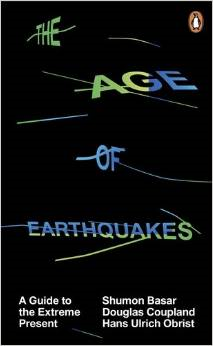
The Age of Earthquakes by Basar, Coupland and Obrist Reviewed


The Age of Earthquakes: A Guide to the Extreme Present by Shumon Basar, Douglas Coupland and Hans Ulrich Obrist is a Marshall McLuhan influenced piece of cultural study. This newly published Penguin paperback seeks to examine where we are now, where we are going and what the impact of the digital revolution is on our earth, our society and our overall being. The central thesis of this book being there is no part of our lives and indeed our being that is not being impacted by the rise of technology we have been witnessing over the last couple of decades.

The design of the book is in many ways signature Coupland and that is strangely comforting, as is the fact it's an affordable little Penguin which you can initially get through in one sitting.

There is humour in here such as the poster style double page "Protect me from Amazon suggests I want". However, that humour is always thought provoking and challenging. This book invites us to think about both the world around us and  the world within us. It asks us to hit the pause button and think about the philosophical and practical implications of the lives we are living. It also has a theological aspect as it asks "what about the soul".

For those wanting to think about the theological implications further I would signpost you to the work of the CODEC team up in Durham whose research is in this area.

One quirky aspect of this book is it includes a set of new terms which seek to encompass some of the contradictions we are experiencing but have no language to express. My personal favourite is "smupid" which refers to the way we're smarter than we've ever been but we feel more stupid than ever before. The Guardian had an article giving an extract providing a glossary of some of the terms used.

This book would act as a good set of discussion starters for a small group of people who are digitally literate. The wide range of sub-themes it includes are varied and go from how we will like things on social media but we don't vote to how the wiring of our brains is changing from taking a linear format to a lattice format. My favourite question is "How do you use yourself as an app?" It seeks to identify our individuality yet the book also questions whether the individual or the mob will win the battle going on at the moment.

The book is one I would certainly recommend to people who want to be challenged to think and to have a laugh. It doesn't give answers as such, rather it raises questions and gives possibilities.
To me it made it a much more engaging book than Digital Vertigo by Andrew Keen which isn't bad and covered some of the same ground but did so in a far more long winded and slightly less entertaining way.

Vice Media has an interesting interview with the authors by Dean Kissick which is worth a look if you want to know more about what this book is about.

The Age of Earthquakes: A Guide to the Extreme Present by Shumon Basar, Douglas Coupland and Hans Ulrich Obrist, 2015, Penguin Books, ISBN 978-0-141-97956-4

Saturday, 14 February 2015

Mission on the Road to Emmaus - A Review


Mission on the Road to Emmaus: Constants, Context and Prophetic Dialogue edited by Cathy Ross and Stephen B. Bevans is a contextual theology book focusing on the theme of prophetic dialogue. It contains essays by fifteen eminent theologians primarily but not exclusively based in the USA and UK; many of the US contributors are academics at Catholic Theological Union in Chicago. However, unlike many texts of this type it consciously seeks not to be overly ethnocentric in its approach. It was pleasing to see Baptist minister and theologian Joe Kapolyo amongst the contributors - he was recently identified by the Baptist Times as one of the emerging African theologians inBritain.

The book is co-edited by Cathy Ross who teaches with a range of institutions around Oxford including Ripon College, Cuddesdon and on the CMS Pioneer course who was also one of the editors of The Pioneer Gift: Explorations in Mission, which I have also reviewed. It contains an essay from Jonny Baker, Mission Education Director of CMS, who was her co-editor on that project.

If at this point one starts to see a web of connection amongst the authors it is no coincidence. In the introduction to this book Bevans and Ross conclude "All these writers are our friends...."

Whilst there may be differences between them in approach and theology there are some strands which run throughout the book including a strong focus on the trinity and the relational nature of God and man. There is also the strong passion for mission each writer clearly has together with the influence of liberation theology on most of them in some form or another. There is also a feeling that much of the book is in some way a response to an earlier work Constants in Context: A Theology of Mission for Today (2004) by Roger Schroeder and Stephen Bevans. Indeed the final chapters of this text by firstly Schroeder and then Bevans appear to confirm this. Perhaps the present book might have been subtitled a reflection on contextual theology ten years on.

The book flows from what one might describe as the more academic and somewhat traditional academic style in the early chapters which focus on Christology, Ecclesiology and  Eschatology to the more narrative and conversational approach in the second half of the book which deals with Soteriology, Anthropology and Culture.

Whilst the book seeks to be accessible to those with differing levels of theological training and understanding the opening chapters are certainly helped by having some background knowledge of some of the key figures and debates in applied, practical or contextual theology over recent decades. That said a lack of familiarity with these should not be a barrier. Breaking all the rules of what is considered good practice I found myself using Wiki on more than one occasion to help me with my understanding of words/ concepts I was not already familiar with and quickly picking up what was being said. I would assume one might also do this with some of the theologians mentioned if one was not familiar.

The first chapter Prophetic Christology in the New Testament by vanThanh Nguyen, one of the Union based contributors, provides an insightful discussion based around Luke 4: 16-21 primarily. It establishes a specific portrait of Christ as one on a prophetic mission.

Continuing looking at Christ Amos Young, a US based academic from Fuller, provides us with Christological Constants in Shifting Contexts: Jesus Christ, and Prophetic Dialogue and the Missio Spiritus in a Pluralistic World. The central thrust of this chapter appears to be that if we look at Jesus as the relational prophet we move away from classical exclusivist understandings to ones which are more able to facilitate meaningful interfaith dialogue.

The final chapter in this section comes from Kirsteen Kim. Within it this professor from Leeds Trinity focuses upon Jesus, Mission and the Holy Spirit in Luke-Acts: Dialogue, Prophecy and Life. It is a chapter which focuses on Christ as both giver and receiver of the spirit and challenges the reader to engage with both Christ and Spirit.

As we move on we reach one of the most interesting and significant chapters in the book, in my opinion. Emma Wild-Wood who has taught in Uganda and the Congo before returning to Cambridge writes about Mission, Ecclesiology and Migration. Within this chapter she unpacks a range of issues facing churches and denominations regarding the challenges raised by migration and the relations between congregations and within them. She looks both at single or similar culture congregations and multicultural congregations as well as exploring resident-alien spirituality, ecclesial practice and mission. I would argue this chapter would make good discussion material for any group seeking to engage seriously with the implications of migration in their area.

Cathy Ross follows this with Hospitality: The Church as 'A Mother with an Open Heart'. It grapples with what is church and argues hospitality is at the centre of the household of God. This could come across as somewhat sentimental in tone but doesn't rather Ross identifies the difficulties and risks involved with taking this approach. In wrestling with these things Ross avoids promoting what De Beauvoir described in The Second Sex as a false gender consciousness, which I feared from the title she might.

Dawn Nothwehr, another Chicago academic, takes up eco theology with The Church's Mission of Ecojustice: A Prophetic Dialogue Approach. Whilst in some ways as polemic as Michael Northcott's work in this area it seemed less angry and frustrated, more patiently screaming out an important message for the church to hear.

There was a poetic start to his chapter as Tim Naish quoted Thomas Hardy as he began to discuss 'Continents of moil and misery': Mission, Justice and Prophetic Dialogue. This Cuddesdon based theorist explored the theme of justice by refering to a range of theorists. In particular he contrasts the differing approaches of Sagovsky and Hauerwas when looking at this from a theological perspective. One particularly interesting aspect of this chapter is Naish's brief discussion of his role as an assistant chaplain at a Immigration Removal Centre and of the challenges this poses in the discussion of justice and how to deal with different situations in the real world.

Moving into the forth section of the book we have Robert Schreiter's Reconciliation and Prophetic Dialogue. This was another particularly strong and challenging chapter from another of those based in Chicago. The nature of reconciliation and healing as part of that process is discussed in a way which shows a deep knowledge and understanding of those processes and much wisdom on the subject.

S. Mark Heim is a professor at the Newton Centre in the US and his chapter on Wounded Communion: Prophetic Dialogue and Salvation in Trinitarian Perspective focuses on exactly what the chapter would suggest. This is one of the more abstract chapters which I believe would benefit from further exploration.

As the book moves on to exploring Anthropology: Mission as What it Means to be Human Frances S. Adeney from the Louisville Presbyterian Theological Seminary gives a chapter which comes from a feminist/ womanist perspective. Within it Adeney looks from three different perspectives at the changes in women's mission theology since World War Two. It is an interesting chapter which whilst in many ways a summary arguing for a greater listening to the prophetic voices coming from women in this area also provides a solid foundation for anybody wanting to explore the recent history of women and mission more.

Maria Cimperman's An Anthology of Prophetic Dialogue: Rooted in Hope is a chapter which focuses on the need for us to hold on to hope in a world which would so often move away from it. This chapter from another of the Chicago stable reflects on a number of recent events and has a very contemporary feel to it.

Joe Kapolyo's chapter is an important one which needs to be heard. Within Prophetic Dialogue and the Human Condition he reflects on deep and surface culture and the need to understand what deep culture means in the African context. Through using his own African cultural background as an example this North London Baptist Minister shows how understanding of the holistic nature of this deep culture means that our understanding of African congregations may need to alter from what it may currently be. He makes the point that as these groups are the fastest growing and the baton of leadership is passing to them that, "The quality of that leadership, upon which the very outlook of the Church will hang, depends on the quality of the prophetic dialogue between the word of God and the deep cultures of the African people groups."

Jonny Baker begins the final section of the book talking about Prophetic Dialogue in Contemporary Culture. This chapter explores developing a cross cultural understanding for mission which does not just relate to ethnic cultures but can also relate to understanding different cultures within the same culture. He makes reference to the differences between high and low cultures and the way in which listening is required to understand alternative cultures. Within this he makes reference to the way in which art is often an important tool in this type of prophetic dialogue.

Then we get to Roger Schroeder and his focus on culture as one of the aspects from Constants in Context within the chapter Prophetic Dialogue and Interculturality. The  Chicago based professor explores aspects of the social sciences and missiology to argue for a transformative approach to prophetic dialogue and interculturality.

Finally Stephen Bevans, also of Chicago, brings it together with what might be described as a defence of contextual theology as an academic and theological approach.

Is it a book worth reading? I would say definitely, although at over £30 the cost may be to be prohibitive to many. I had to consider this very carefully, even with a marketing discount from Eden to put towards the cost. Yet I think it is worth it. It is a book which should be more widely read than just by theology students dipping into chapters for seminars or essays.

Divided into the six portions I am going to explore it in more detail over Lent.

Mission on the Road to Emmaus: Constants, Context and Prophetic Dialogue, Edited by Cathy Ross and Stephen B. Bevans, (2015), SCM Press - ISBN:978-0-334-0409-8